Consistency, But in Excellence Not Appearance
Consistency serves a purpose in visual design, but it seems to have become the purpose of a lot of visual design.
Look no further than these evolutions of macOS icons (image courtesy of BasicAppleGuy):
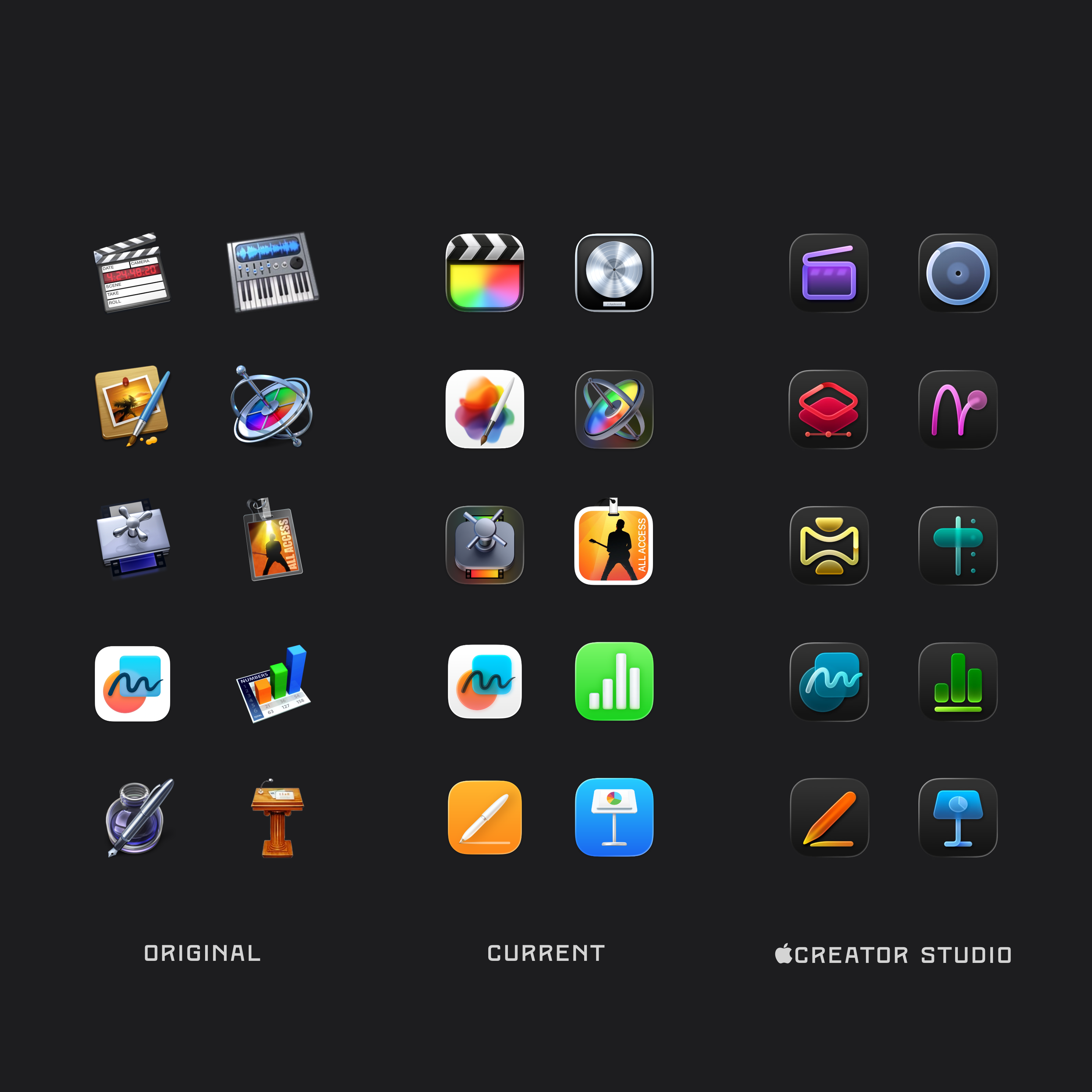
The Creator Studio icons are undeniably consistent visually: rounded rectangles, controlled gradients, simplified forms, restrained depth, etc.
In contrast (and by modern standards) the originals seem heretically inconsistent. They lack coherence in visual details like shape, material, and lighting.
But what they lack in visual consistency between one another, they make up for in excellence individually.
In fact, their aversion to familial visual consistency almost seems like an intentional choice — a deliberate augmentation of individual purpose.
What purpose? To be singularly representative and deeply iconic.
Icons that are iconic.
To be iconic, by definition, is to be famously distinctive.
None of the Creator Studio icons, especially when held up as a suite, are iconic. None are atypical, they’re merely typical.
All in pursuit of what, consistency — amongst each other and across platforms — as the overriding goal?
This over-emphasis on “systems” design seems endemic to modern software.
Systems prescribe rules because they are the easiest attributes to document, enforce, and automate — “All icons must use this shape, this lighting, this stroke.”
Excellence, by contrast, is harder to systematize. It requires judgment, taste, care, experience, and a sensitivity to context — all in service of meaning and purpose, not superficial similarity.
When you strive for consistency across a suite, individual elements lose their ability to be exceptional and iconic on their own terms. Consistency for the group becomes a ceiling on individual excellence.
But if you flip that, if you make excellence the goal for each individual element, something interesting can happen: excellence becomes your motif of consistency. It’s no longer a consistency of shapes and gradients, but one of quality and intention that serves a deeper meaning and purpose than superficial visuals.
Give me a consistency of excellence any day over a consistency of appearance.